

E-commerce website design for stores that move product
Stores built around how your customers actually shop, ready for Google Shopping from launch. And an honest answer if a store isn’t what you need.
We build a store when a store pays
A Regina jeweller had a $350 buyer and a $7,250 buyer scrolling the same twelve-page list. We rebuilt the store with a path for each, and orders doubled in the first full month.
A home centre with a big catalog came to us for a store. He didn’t need one, so we built a catalog site instead. That’s the whole approach: a store when it will earn its keep, and the straight answer when it won’t.
We build on WooCommerce and Shopify. WooCommerce gives you full ownership with no platform subscription. Shopify handles more of the running for you, which is why the jeweller’s store is on it. We’ll recommend the one that fits how you sell.
Either way, the store doesn’t have to stand alone. We connect it to the apps and outside software your business runs on, so it can grow past a simple shop.
What’s included
- Product and category structure
- Product page templates
- Search and filtering
- Checkout and payments
- Shipping and tax set up for Canada
- A product feed ready for Google Shopping
- Shopify apps and outside software, connected
- Speed at catalog scale
- Sales tracking
How we make it perform
Every page of a store is a salesperson. These are the things that make them good at it.
a store only when it earns its keep
Structure buyers can navigate
Categories and filters that match how customers think, not how the stockroom is organized. People find the product in a few taps.
Product feeds
Titles, prices and images set up for Google Shopping from launch, so ads can run without a rebuild.
Cart recovery
Reminder emails and ad audiences for shoppers who left something in their cart. Some of them only needed a nudge.
Trust signals
Clear shipping, returns, real photos and secure checkout, shown where a buyer hesitates. Doubt is the main reason carts get left.
Speed with a big catalog
Compressed images and lean code, so a store with thousands of products still loads fast on a phone.
Do you even need a store?
Sometimes a catalog that sends people to call or visit sells more, with less work for you. We’ll say so.
Shopify apps and outside software for bigger stores
A growing store has to talk to the rest of the business. Your stock, your books, your warehouse and your email list. We connect them, so orders, inventory and customers stay in step without anyone retyping them.
On Shopify, most of that comes from apps. We choose the ones that do the job, set them up properly and keep the count down. Every extra app is another monthly fee and another script for the page to load.
When a store needs more than an app can give, we bring in outside software built for the job and connect it to the store. Wholesale accounts, stock across locations and high order volumes all fit on the same storefront.
What we connect
- Inventory and ERP systems
- Accounting and invoicing
- Point of sale for in-store sales
- Warehouses, 3PLs and shipping
- Email and SMS marketing
- Reviews, subscriptions and loyalty
- Wholesale pricing and B2B accounts
Wholesale beside retail
Trade customers log in to their own prices and terms. Retail shoppers see the shelf price. One store, one stockroom.
One count across every location
The shop floor and the website sell from the same stock. Connected inventory and point of sale stop both from selling the last one.
Orders straight to fulfilment
New orders go to your warehouse or 3PL, and tracking goes back to the customer. Nobody copies an address by hand.
Proof from real clients
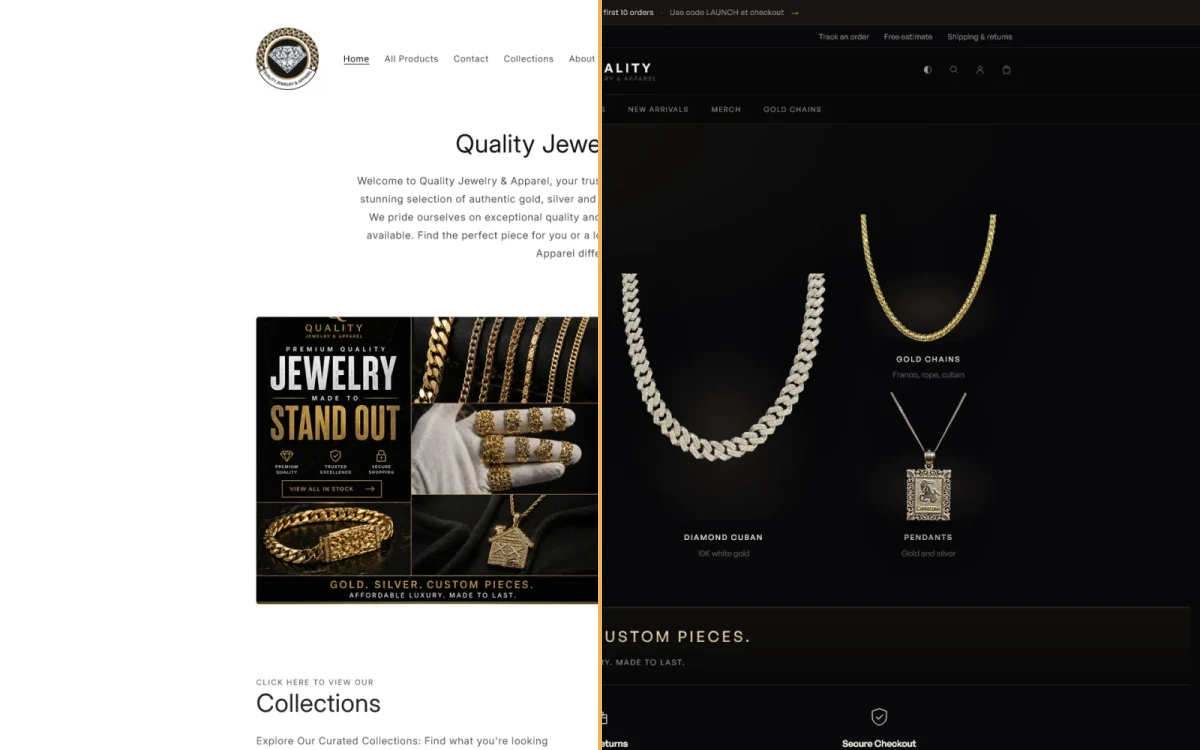
Orders doubled in a month: rebuilding Quality Jewelry & Apparel
Every piece sat in one alphabetical list twelve pages deep. Here’s the Shopify storefront we built instead.
Read the case study
A full catalog without the e-commerce headache: Mike’s Home Centre
A big catalog and no interest in running a web store. Most agencies would have sold him one anyway.
Read the case studyE-commerce questions, straight answers
What owners ask us most. Anything else, bring it to your free Growth Session.
Shopify or WooCommerce?
We build on both. WooCommerce suits stores that want to own everything and control every page, with no platform subscription. Shopify suits stores that would rather the platform handle hosting, security and updates for a monthly fee. We’ll recommend one based on your products and how you want to run the store.
How much does an online store cost?
It depends on the number of products, how they’re organized and what has to connect to the store. Every build gets a fixed quote after a scoping call, before any work starts.
Can you move my existing store without losing sales or rankings?
Yes. We map every old product and category address to its new one, move your customer and order data where the platforms allow it, and launch when it’s quiet. Redirects keep your rankings pointed at the right pages.
Will it be ready for Google Shopping ads?
Yes. The product feed is set up as part of the build, so Shopping and Performance Max campaigns can run from launch.
Can the store connect to the software we already use?
Usually, yes. Most inventory, accounting, point of sale, shipping and email tools connect to Shopify through an app. Where an app can’t handle it, outside software usually can, and we connect that to the store instead. Send us your list before the scoping call and the quote will cover every connection.
I have a big catalog but don’t want to run a web store. What are my options?
A catalog site. Customers browse everything you carry, see what’s in stock and call or come in to buy. No carts, no shipping, no online payments to manage. We’ve built one for a client who came to us asking for a store.
Why choose Canwest for e-commerce?
We’ll build a store when it pays and tell you when it won’t. The same team runs the Shopping ads and SEO, so the store is built to be marketed. Fixed quotes and everything in your name.
Ready for a store that sells?
Book a free Growth Session. We’ll look at your products and your customers and tell you whether a store, a catalog or a fix to your current site makes the most sense.