Educational How to Find Your Best-Converting Google Ads Keywords (Without Setting Money on Fire)
Most business owners look at ad spend that didn’t produce a sale and see money lost.
The ones who actually scale look at the same number and see money spent buying information.
That reframe is the whole game. When you first turn on Google Ads, you don’t know which searches turn into paying customers and which just burn budget. Nobody does. The only way to find out is to spend a little, watch closely, and read what the results are telling you. Every dollar that doesn’t convert isn’t a failure — it’s you paying to learn which keywords do convert, so you can pour money into those with confidence.
Get comfortable with that idea and the rest of this gets a lot less scary.
Treat your early spend as an experimentation budget
Here’s a mindset worth stealing. Set aside a chunk of money specifically to learn — a bet you place on your own future skill, where you expect some early losses because the thing you’re actually buying is the lesson.
Google Ads works exactly like that at the start. Your first few weeks aren’t “the campaign.” They’re the experiment that tells you what the campaign should be. You’re testing keywords, audiences, ad copy, and landing pages to find the handful that print money. Some tests lose. That’s the cost of finding the winners, and the winners more than pay for the losers once you know who they are.
The businesses that quit Google Ads usually quit here — a few weeks in, before the data has told them anything, deciding “ads don’t work for us.” What actually happened is they stopped paying for the lesson right before it arrived, and handed the channel to a competitor who didn’t.
Set your number before you spend a dollar
You can’t tell a winning keyword from a losing one without a line in the sand. So draw it first.
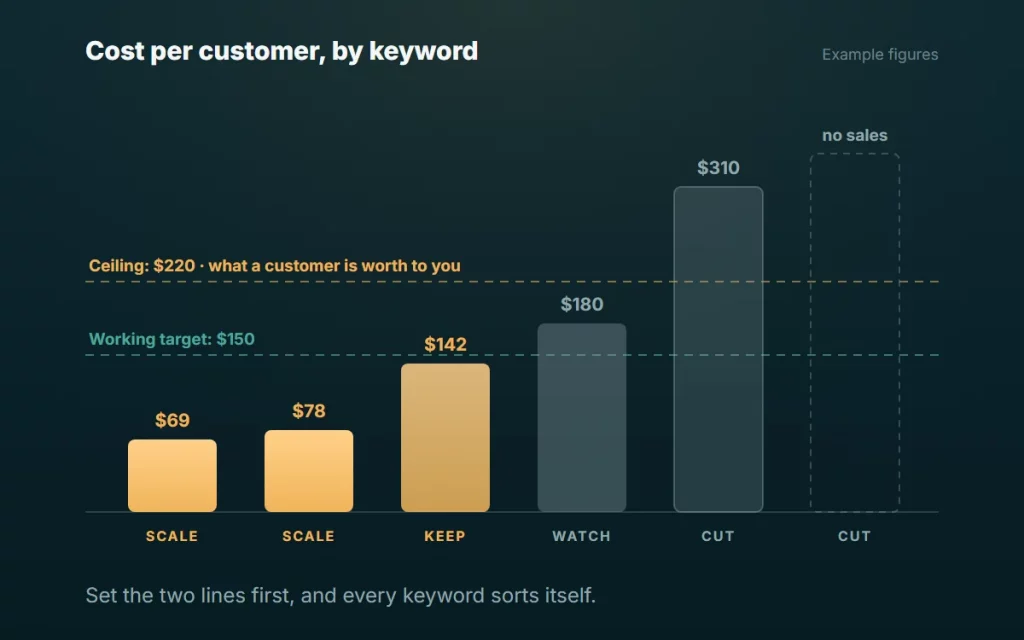
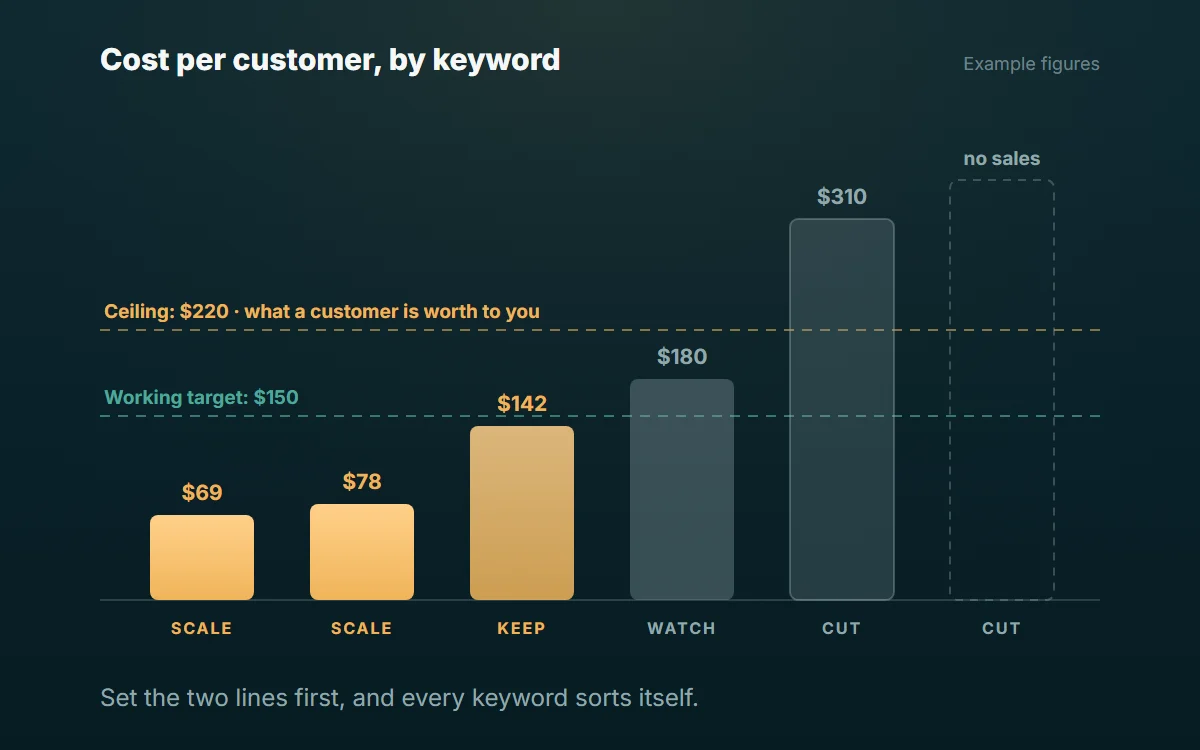
The number that matters most is your cost per conversion — what it costs you in ad spend to get one new customer. The math is simple: total ad spend divided by the number of customers it produced. Spend $1,000, get 10 customers, your cost per conversion is $100.
Now the important part. Work out the most you can pay for a customer and still make good money, given what that customer is worth to you over time. That’s your ceiling. Then set your working target a bit below it — leave yourself room to test things that might underperform at first. If a keyword brings customers in under your target, that’s a winner, feed it. If a keyword keeps blowing past your target with nothing to show, that’s a loser, cut it.
Without that number, you’re just staring at a dashboard feeling good or bad about it. With it, every keyword sorts itself into “scale this” or “kill this.”
Find the money keywords — and cut the ones bleeding you
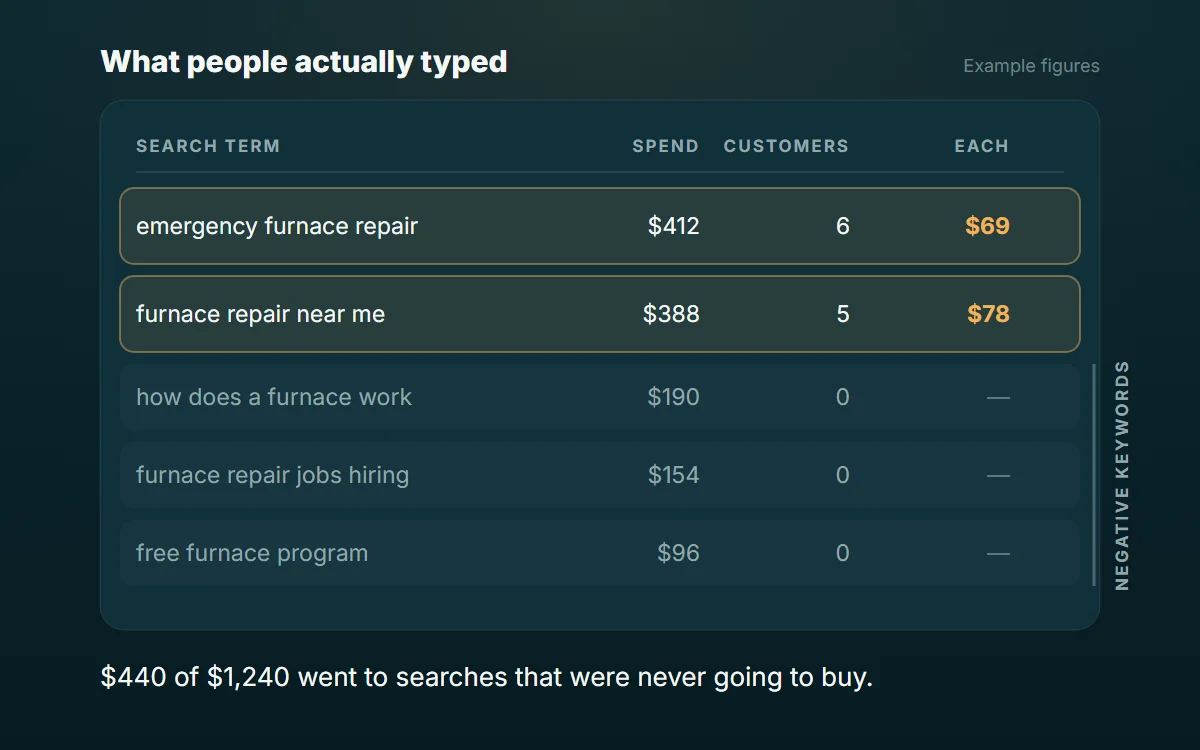
Once the data’s coming in, the single most valuable report in your account is the search terms report. It shows you the actual things people typed before they saw your ad — not the keywords you targeted, the real searches.
Sort it by spend and look for two things. First, the searches eating budget without producing customers. Add those as negative keywords so you stop paying for them — that alone often frees up a meaningful chunk of budget overnight. Second, the searches quietly converting well below your target. Those are your money keywords. Lean into them.
One more lever that lowers your cost quietly: alignment. When the search, your ad, and the page it lands on all say the same thing, Google rewards you with a lower cost per click. If someone searches “emergency furnace repair,” your ad should say emergency furnace repair, and it should land them on a page about emergency furnace repair — not your generic homepage. Match the promise all the way through and you pay less for the same customer.
The 2026 reality: you’re coaching an algorithm, not hand-picking every word
If your mental model of Google Ads is picking a list of keywords and setting a bid on each, it’s a few years out of date.
Today, Performance Max, broad match, and Google’s automated bidding make most of the moment-to-moment decisions. You’re not hand-selecting every keyword anymore. The job has shifted: instead of controlling the machine, you’re training it. And a machine trained on bad signals optimizes toward bad outcomes — lots of cheap clicks, no customers.
So your real work now is feeding the algorithm clean information. Make sure it’s counting actual leads and sales as conversions, not just form-page visits or clicks. Give it strong negative keywords so it learns where not to go. Give it good ad copy and a landing page that converts. Do that, and the automation optimizes toward real customers instead of vanity clicks. Fight it or feed it junk, and it happily spends your money finding you nothing. Work with it.
Running out of cheap wins? Reach people earlier in the journey
At some point you’ll have squeezed the obvious searches — the people typing your exact service with buying intent right now. That’s the “ready to buy today” crowd, and it’s a small pool. To grow past it, you have to reach people earlier.
Think of it as levels of awareness. Some people are ready to buy and just need to pick who. Others know they have a problem but haven’t decided on a solution yet. Others barely know the problem has a fix. Growth means writing ads and building pages that meet those earlier-stage people where they are — different message, different intent, often a page that bridges them from “curious” to “ready.” It’s more work than harvesting the ready-to-buy searches, but it’s where real scale comes from once the easy wins are gone.
The honest part: you can learn to do this yourself
Here’s something most agencies won’t put in writing.
You can learn to read your own numbers. If you already pay someone to run your ads, don’t just hand it over and hope. Keep your hand on the mouse. Get on a regular call, have them walk you through the search terms report and your cost per conversion while you do the clicking, and within a few weeks you’ll understand your own account well enough to know whether it’s working. That knowledge is yours to keep, and it’s the best insurance there is against wasted spend.
We think that’s genuinely good advice, even though we run ads for a living.
The reason people still hire us anyway is time. Learning this properly, then doing it well every week — reading reports, pruning negatives, testing pages, feeding the algorithm — is a real job on top of the one you already have. Some owners want the skill. Plenty more just want the result without the learning curve, so they can keep running their business while the leads come in. That’s the trade, and only you know which side of it you’re on.
The two versions of next quarter
Read the numbers and the account gets simple. You know what a customer costs, which searches produce them, and how far you can push spend before it stops being worth it. That is the point where advertising turns into a decision you make on purpose instead of a bill you brace for.
Ignore them and the money still leaves your account on the first of every month. It just stops teaching you anything. Twelve months of that is a five-figure education you paid for and never collected.
There is immediate relief in it too. The first pass through a search terms report almost always finds budget going to searches that were never going to buy — people looking for jobs, for free, for a how-to. Cutting those does not take a bigger budget. It gives you back the one you already have.
And if you leave it, nothing dramatic happens, which is exactly the trap. The ads keep running. Some leads keep arriving. You just pay more per customer than the competitor down the road who reads their reports, and you never find out that is why they can afford to outbid you.
Want a read on where your budget’s actually going?
If you’re already spending on Google Ads, send us access for a quick review. We’ll tell you your cost per conversion, where budget’s leaking, and the keywords worth doubling down on — no pitch, just a straight look at the numbers.
Want This Handled?
Book a free Growth Session. We audit what you have now and map exactly what it takes to grow, whether you hire us or do it yourself.
Get My Free Growth SessionKeep Reading
All posts →
Why Your Website Isn’t Generating Leads (and How to Tell What’s Actually Wrong)
Getting traffic but no leads? Here's how to tell whether it's a traffic or conversion problem, and the real reasons your website isn't turning visitors into calls.
Google Business Profile Optimization: The Free Real Estate Most Local Businesses Waste
Most local businesses use a fraction of their Google Business Profile. Here's how to optimize it, including the new social-links feature, to show up first.

Millions of Views, Then Actual Sales: Mindful Singers
Jordan was selling every hour he had. Growth had to come from somewhere other than his calendar.